
Digital Visibility: How to Become Essential in 2026
SEO, GEO, social media, SEA, generative AI: the five strategic pillars transforming a company's online presence — from awareness to commercial performance.
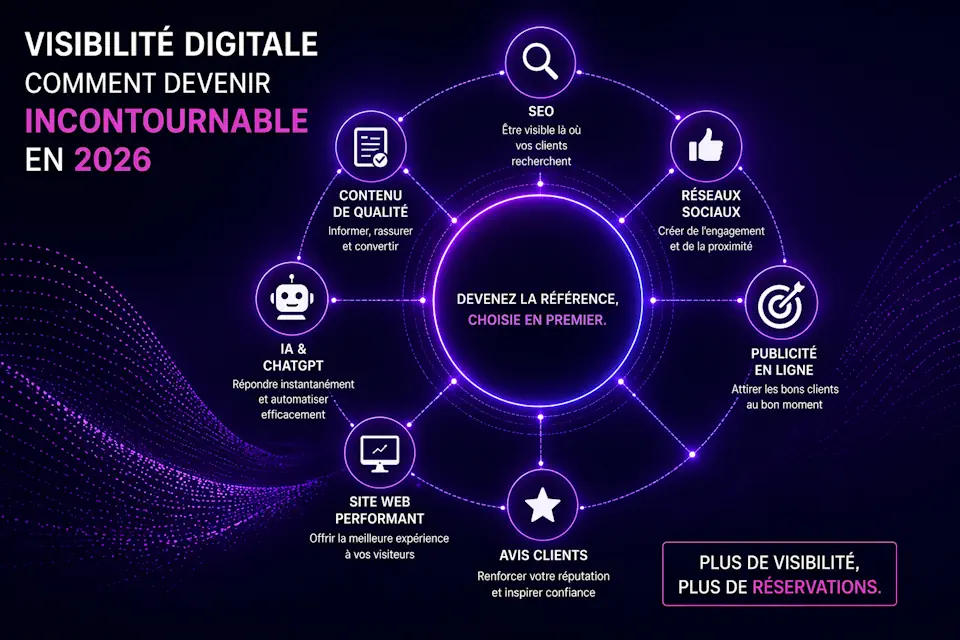
Digital visibility has become an essential strategic lever for any organization wishing to exist, develop, and perform. It is no longer limited to "being present online": it means being visible at the right time, in the right place, and to the right people, with a relevant message. Five pillars now structure this visibility: natural referencing (SEO), local referencing (GEO), social networks, online advertising (SEA), and presence in AI search engines (AEO). The question is no longer "how to be visible?" but "how to become essential in one's field?".
1. Definition and Challenges of Digital Visibility
Digital visibility refers to the ability of a company, brand, or individual to appear and be identified on various digital channels: search engines, social networks, booking platforms, marketplaces, smart assistants.
Customer behavior has profoundly evolved over the past few years:
- Online information search before any purchase decision
- Instant comparison of prices, products, and services
- Systematic consultation of customer reviews
- Conversational search via AI (ChatGPT, Gemini, Perplexity, Claude)
In this context, visibility directly conditions three pillars of performance:
Today, not being visible is almost like not existing. A company absent from search engines, invisible on Google Maps, or never mentioned by AI loses a substantial portion of its potential market to better-positioned competitors.
2. The Five Pillars of Digital Visibility
Search Engine Optimization
SEO (Search Engine Optimization) consists of optimizing a website to appear in organic search results of search engines like Google. It relies on three complementary axes:
- Technical optimization: loading speed, site structure, mobile compatibility, Core Web Vitals, indexation
- Content quality: accurately responding to search intent with useful, unique, structured content
- Popularity: obtaining inbound links from quality sites (backlinks, mentions)
Good SEO allows for sustainable, qualified traffic with high conversion potential, without direct dependence on a continuous advertising budget.
Local SEO (Google Maps)
For businesses rooted in a territory — shops, hotels, campsites, restaurants, artisans, local services — local visibility is often the number one lever. Key elements:
- An optimized Google Business Profile (photos, opening hours, attributes, services)
- Numerous and recent customer reviews (at least 30 reviews, average rating 4.5+/5)
- Accurate and consistent information across the web (NAP: name, address, phone)
- Schema.org LocalBusiness markup on the website
Local SEO captures a particularly strong purchase intent: "I'm looking here and now."
Instagram, Facebook, LinkedIn, TikTok
Social platforms play an essential role in building visibility. They allow to:
- Build a lasting relationship with a community
- Enhance brand image (positioning, values, behind-the-scenes)
- Generate traffic to the website and inbound inquiries
Be careful, however: organic visibility is increasingly limited. An effective social strategy now combines organic content (for brand image) and targeted paid campaigns (to reach new audiences).
Online Advertising
SEA (Search Engine Advertising) allows immediate appearance at the top of search results through paid campaigns on Google Ads, Meta Ads, or LinkedIn Ads. Its advantages:
- Speed: visibility from the launch of the campaign
- Precise targeting: geographical, interests, keywords, period, language
- Budget control: managed daily investment
SEA is a complementary lever to SEO, particularly effective for generating short-term conversions, testing a market, or compensating for young SEO.
Visibility in AI Search Engines
With the emergence of ChatGPT, Gemini, Perplexity, and Claude, a new form of visibility is appearing: being cited directly in generated answers. This is called Answer Engine Optimization (AEO) or Generative Engine Optimization (GEO).
To be cited by an AI, three conditions:
- Clear, structured, and factual content (lists, tables, Q&A)
- Direct answers to actual user questions
- Strong authority: citations in Wikipedia, recognized press, specialized directories, official sources
This is the new frontier of referencing. Companies that invest in AEO now gain a head start for the coming years.
3. Key Factors for Success
An effective digital visibility strategy relies on five fundamental principles transversal to all channels:
- Understanding user intent: accurately responding to the real needs of target customers, not just what is assumed
- Content quality: informative, useful, differentiating, and up-to-date
- Global consistency: website, social media, customer reviews, and advertising tell the same story
- Regularity: continuous publishing and optimization, not in bursts
- Data analysis: adjusting the strategy based on measured performance (Google Search Console, Analytics, Google Ads)
4. Current Challenges (and How to Overcome Them)
Digital visibility faces several major challenges in 2026:
- Content saturation: competition is increasing across all channels. Response: focus on niche expertise and specialization to differentiate.
- Constant algorithm evolution: Google, Meta, and AI are constantly evolving. Response: rely on fundamentals (intent, quality, authority) rather than tricks.
- Rise of artificial intelligence: rapid transformation of search and discovery modes. Response: structure content into factual Q&A citeable by AI.
- Platform dependency: Meta changes its rules, marketplaces take high commissions. Response: invest in your own organic visibility and direct channels (website, email, customer base).
Successful companies are those that adopt an agile and strategic approach, capable of adapting without losing their identity.
5. Towards a Global and Smart Visibility
Digital visibility should no longer be thought of in silos (SEO on one side, social media on the other, advertising separately), but as a global ecosystem.
The goal is no longer just to attract traffic. It is now to:
- Capture attention at the right moment in the customer journey
- Inspire trust through consistency, reviews, and social proof
- Convert into commercial action (purchase, quote, contact)
- Retain to transform each customer into an ambassador and generate recommendations
The most successful brands today are those that intelligently combine all levers around a clear, user-oriented vision and measurable results.
Conclusion
Digital visibility has become a central issue in a company's success. It does not rely on a single lever, but on a coherent, structured, and evolving strategy.
In the digital and artificial intelligence age, the question is no longer "how to be visible?" but "how to become essential in your field?". The good news: companies that invest now in a truly global strategy gain a head start that is difficult for their competitors to catch up on.
Frequently Asked Questions
Which pillar should one start with on a limited budget?
For a small to medium-sized business with a constrained budget, two priorities: (1) the Google Business Profile listing — free and very profitable for local businesses, and (2) basic SEO on the website (speed, structure, content of main pages). These two levers lay lasting foundations before any advertising investment.
How long does it take to see results from a digital visibility strategy?
Timelines vary depending on the levers. SEA (advertising) generates traffic from day one. Social media shows its first effects in 1 to 3 months. Organic SEO takes 3 to 9 months to rank solidly for competitive keywords. AEO (generative AI) improves over 6 to 12 months with structured content and strengthened authority.
Is it essential to be present on all social networks?
No. It is better to have two well-maintained networks than a scattered presence on five abandoned platforms. Choose the networks where your customers actually are: Instagram/TikTok for the general public and B2C, LinkedIn for B2B, Facebook for local loyalty, YouTube for long-form, high-value content.
How to be cited by ChatGPT, Gemini, or Perplexity?
Three conditions must be met: (1) structured content in Q&A, lists, tables, with schema.org markup (FAQPage, HowTo, Article), (2) strong thematic authority (citations in the press, Wikipedia, reputable directories), (3) precise and recurring named entities (location, profession, brand, specialty).
SEO or SEA: which to prioritize?
Both are complementary, not competing. SEA brings immediate traffic but depends on a continuous budget. SEO takes time but builds a lasting asset. The winning strategy: start with SEA to test keywords and quickly generate conversions, then gradually shift to SEO to reduce customer acquisition cost.
Is digital visibility relevant for a very local business?
Yes, even more so than on a national scale. In Castellane, in the Verdon, or in any rural area, digital competition is often limited: a well-executed local strategy (Google Business Profile, local SEO, customer reviews, targeted social media) allows you to quickly dominate your territory. A modest investment can generate a much higher return there than a diluted national campaign.
Want a free digital visibility diagnostic?
I offer a free 30-minute audit to analyze your online presence, identify weaknesses, and define priorities. Zero commitment, a real action plan included.
To learn more: consult Google's official SEO guide and the schema.org BlogPosting documentation.